11/11/2025
New metadata best practices have been developed to support the discoverability of First Nations books and publishing across the industry supply chain.
The new best practice documents on bibliographic standards have
been published by international standards organization EDItEUR outlining ways to highlight
Indigenous content and contributors using ONIX and Thema. These have been
produced in collaboration with the Australian Publishers Association, BookNet
Canada, and the BTLF, building on efforts started in 2023.
An
introductory non technical overview along with worked examples from around the world, including titles from Australia
and Aotearoa New Zealand, accompany two standards documents for ONIX and Thema
which aim to help users explore how they might improve their metadata:
Representing Australian First Nations content
A number of Australian publishers and their staff supported the APA in drafting the documents. One contributor was Dr Arlie Alizzi, editor at Magabala Books and winner of the 2025 Rising Star award, who says of the resulting best practices:
“These documents provide some usable and straightforward ways to flag Indigenous content and creators in Australian metadata using ONIX and Thema systems. They outline some important further considerations for the industry and will be a great conversation starter.”
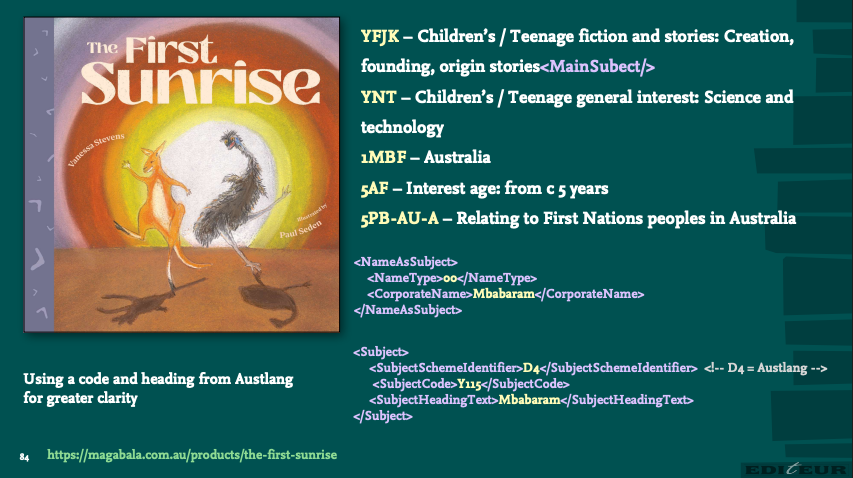 Example of the use of Austlang in the metadata for a title, taken from the worked examples document.
One of the most significant ONIX changes emerging from this work is a new contributor-place relationship which enables a respectful, structured way for Indigenous contributors to be identified in metadata, when and how they choose to be. The inclusion of Austlang as a recognised subject classification scheme similarly allows information about Indigenous Australian languages to be clearly attributed through ONIX.
Leading the APA’s engagement in this international development was
Cat Colwell, head of product and supply chain, who notes:
“These documents are a starting point for better representing First
Nations participation and values in our book metadata. We believe in evolving
standards over time, so that they remain relevant and reflect the diversity of
peoples and cultures, as well as the richness and variety of content in the
books that are published. I would like to thank the Indigenous publishers and
consultants from Australia and around the world who supported us throughout
these efforts to decolonise Thema and ONIX, and support Indigenous data
sovereignty.”
Colwell acknowledges however that this is just the beginning of the
journey, saying:
“It’s really positive that Austlang is now recognised within ONIX
as a new classification scheme, creating the capacity for books in First
Nations languages to be properly classified and found. This ties into priority
areas of the National Cultural Policy Revive, and supports wider initiatives
across the arts such as Voices of Country. But it also presents a challenge –
how do we ensure it improves practical discoverability in the supply chain?
More work is needed here, and will be an ongoing focus for the industry so
these identifiers become meaningful tools for cultural recognition, respect,
and discovery.”
Implementing this best practice
As a first step the industry, particularly publishers, data
suppliers and recipients such as bookstores, should use these documents to
consider respectful implementation in their workflows and systems. These
resources are intended to support discussion and encourage reflection on how
metadata is currently used. Publishers and contributors may choose to use the
metadata differently from that described. Additional approaches may emerge
through conversations with Elders, contributors, readers, and other
stakeholders, which are expected to unfold in subsequent rounds of
consultation and engagement with metadata suppliers and consumers.
The new documents are available to download from our metadata resources pages. Feedback is encouraged and will be integrated into subsequent editions of
the documents – share your thoughts and experiences using these with others
through the
Australian metadata discussion group, or directly with Cat Colwell.